Skip to content
Rep Loader
16 muscle groups11 physique templates4 AI coachesAdaptive loadingRecovery sensorBody comp planner
14-day calibration trial · No credit card · See pricing
Adaptive Rep Loading

The right weight. The right reps. Every set.

Rep Loader calculates the best practical load and rep target for your next set, then recalibrates as you train.

Beat the target, miss the target, change the load, run straight sets, pyramids, or reverse pyramids. Rep Loader adjusts the next load to keep your reps in the hypertrophy range.

Rep Loader pushes every set close to failure. You get maximum hypertrophy for the fatigue you accumulate.
Smart Progressive Overload

Rep Loader crunches the numbers so you don’t have to.

Ask a lifter how to progressively overload an exercise, and you’ll usually hear something like this: “Add reps until you hit the top of the range, then increase the weight.”

As a general rule, that makes sense. In practice, it gets messy, quick.

What if I'm doing pyramid sets? What if I beat the target by two reps? What if I come up short? What if the next load is not available? What if I'm not feeling it today?

Rep Loader compares your current performance against what you did last session, adds progressive overload (you control how much), adjusts for fatigue, and gives you a rep target just within reach.

No more guessing.

Set Analytics

See what changed, and why.

One graph connects your previous performance, the set you just logged, and the assignments still to come. See what happened—and what you’re working toward.

Take an incline dumbbell press: your target is 10 reps at 110 lb. You get 12. You beat the target, but that doesn’t automatically mean adding weight to the next set.

In this example, the next assignment stays at 110 lb for 10 reps. The work you’ve already done matters too. Adaptation can mean changing the load, changing the reps, or keeping the target where it belongs.

Your coach explains the result and the next assignment, so the numbers come with a purpose.

Explore coaching
Feeling Strong?

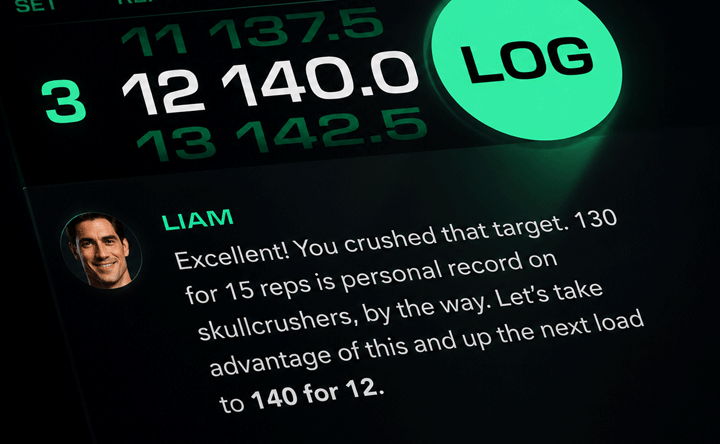
Go heavier to capitalize on strength.

You slept well. You carb loaded. You had an extra day off. You’re coming in hot.

Your target was 130 pounds for 12 reps and you cranked out 15. The system recalculates your strength for that exercise, applies fatigue expectations for the next set, and makes the next rep/load target harder.
Feeling Weak?

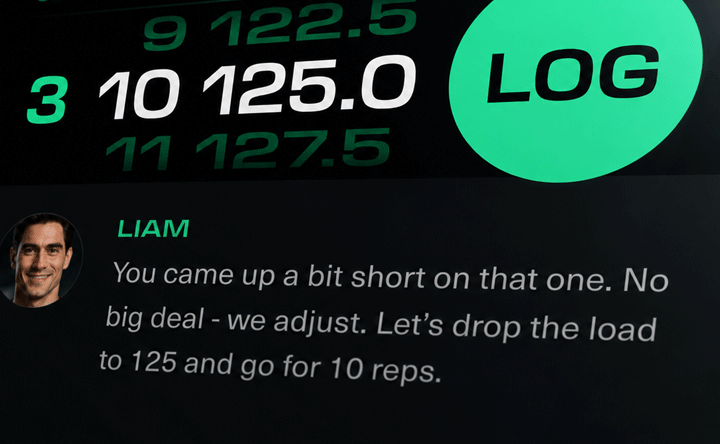
Adjust lower to stay in the rep range.

You tossed and turned all night. You’re stressed out, hung over, or just not feeling it.

Your coach expected 12 reps and you hit the wall at 10. The system reduces the load so you can keep hitting the target reps.

Limited equipment? No problem

Rep Loader adapts to your available equipment.

Before it learns, Rep Loader may target a load you don’t have. Maybe it calls for 32.5-pound dumbbells, but your gym only has 30s and 35s.

No problem. Dial the load up or down to the nearest available weight. Rep Loader adjusts the rep target to maintain the same effort level.

Over time, it learns which loads are available to you and stops presenting targets you can’t actually load.

As a result, your set pattern might not be a tidy 15-12-10-8. It might become 16-13-11-7.

Feel like trying a heavy triple? Dial the reps down and watch the load climb. Rep Loader gives you the best-fit load for those three heavy reps, based on your actual performance history.

No more guessing what you might be able to lift.

Adjust the load and the reps snap to the best-fit target.

intensify your workouts

Rep Loader takes out the garbage (sets).

A garbage set is any set not taken near to failure.

Maybe you picked a starting weight that is too light, but you stop at your usual rep count, leaving the most productive reps still in the tank. Fatigue was accumulated in the muscle with little growth stimulus to show for it.

Rep Loader pushes you to your limit on every set (and beyond when you factor in progressive overload) for maximum hypertrophy.

Bonus: having an accurate rep target also helps your mental game. When you know you can do 10 reps with that weight, you’re less likely to give up at 8.

Rep Loader doesn’t just track your workout.
It raises the bar.
Explore advanced techniques
Exercise Selection

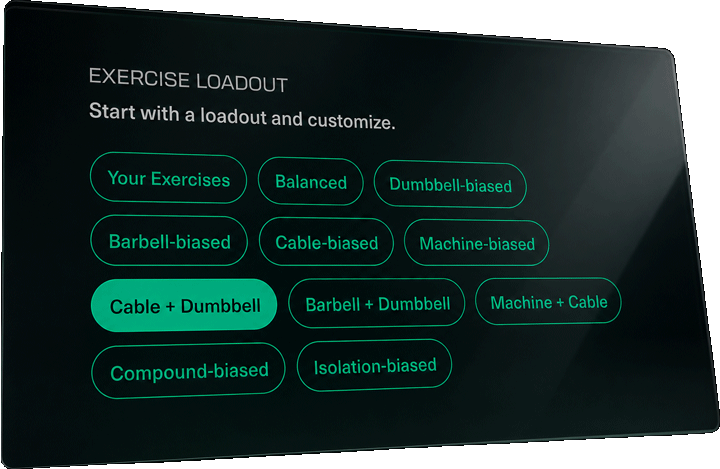
Exercise loadouts that fit your equipment, preferences and limitations.

Not sure what exercises to choose? Rep Loader starts you off with a balanced loadout.

Each loadout consists of up to four exercises per muscle group: a collection of compound and isolation movements curated to stimulate the muscle from different angles and loading biases, lengthened or shortened.

Change it to the one that fits your available equipment and preferred training style. Prefer big compound movements? Check. Prefer to use dumbbells whenever possible? Rep Loader has you covered.

Exercise loadout options in Rep Loader
Set-by-Set Training FAQ

A clear target.
A clearer understanding.

What is a rep/load target?

It means the weight and reps are paired together. A target of 100 lbs x 12 is different from 100 lbs x 8 or 90 lbs x 15.

The load only makes sense in relation to the rep target, and the rep target only makes sense in relation to the load. Rep Loader calculates both together so the set lands near the intended difficulty and stimulus.

The right weight without the right reps is guesswork. The right reps with the wrong weight is also guesswork.

What if the system calls for a load I don’t have?

Dial the load up or down to the nearest available weight. Rep Loader adjusts the rep target to keep the effort level aligned with the plan.

Over time, it learns which loads you actually have access to and stops suggesting unavailable targets.

Does every exercise use the same rep range?

No. A squat is not a curl. A lateral raise is not a leg press.

Rep Loader respects exercise-specific rep ecology: the rep ranges where a movement tends to produce useful target-muscle work with acceptable fatigue, risk, and progression precision.

Heavy compounds bias toward lower reps. Stable machines may tolerate moderate-to-high rep work. Isolation movements often progress better with smaller load jumps and higher-rep targets.

You can also override the rep range for any exercise to suit your preferences.

What is my voluntary failure point?

Your voluntary failure point is the effort level at which you normally stop a set. For some lifters, that means technical failure. For others, it means stopping with one or two reps in reserve.

The exact definition matters less than consistency. Rep Loader learns your pattern and uses it to make better predictions.

If you prefer to manage effort with RIR, enable RIR mode during setup. If you don’t know what RIR means, leave it off and train normally.

Set-by-Set Training

Make your next set
an informed one.

Know what to lift. Log what you do. Get your next target—and a coach who explains it. Experience set-by-set training with your free 14-day trial.

Start your free 14-day trial
No credit card required. No obligation. Just lift.